Watering-Can Swing: Back-Garden Percussion for UK Funky Grooves
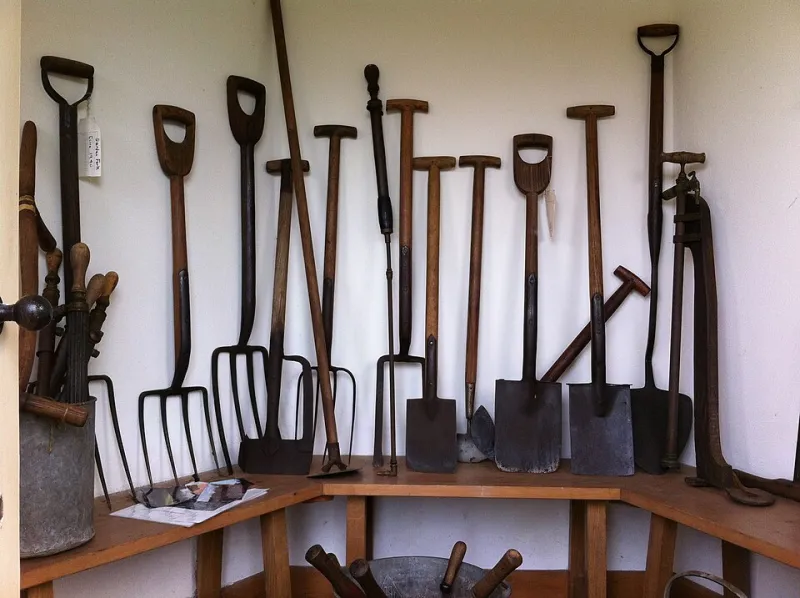
Photo: A J Paxton , CC BY-SA 2.0, via Wikimedia Commons
Every producer has a sample pack full of shakers that sound like they were recorded in a bank vault. Your shed is messier, cheaper and infinitely more useful. The trick is capturing garden tools before the neighbours start twitching at their curtains, then shaping those hits into something that swings like UK funky rather than clatters like bin day.
Pick three hits, not twenty
A watering can, a plastic seed tray, a length of bamboo cane and a rusty rake will cover more ground than a full shelf of metal percussion. The watering can gives you a hollow rim or low tom. The seed tray is your shaker. Bamboo cane is a woodblock with attitude. The rake is a scrape, a rattle or a warning to the cat.
Audition everything before you plug in a microphone. Tap with a finger, a felt mallet and the back of a spoon. If an object has a loose handle or a rattling bracket, either fix it or lean into the rattle. What you do not want is a hit that sounds like a cutlery drawer falling down stairs when you were aiming for a clean percussion layer.
The shed audition: ring versus rattle
Hold each object away from your body and hit it once. Listen for the tail. A good garden hit has a short, readable body and a little air around it. A bad one has a metallic ring that hangs around like a guest who will not leave. Damping is your friend. A tea towel taped to the side of a watering can shortens the ring. A sock around the base of a bamboo cane kills the hollow boom. Blu Tack on a seed tray turns a flappy plastic thud into a tight little shaker.
Do not over-damp. You still want the object to sound like itself. The charm is in the wonk.
Mic placement when the garden is the studio
A cardioid dynamic mic is perfect here. You do not need a condenser and you definitely do not need a matched pair. Put the mic 5 to 15 centimetres from the hit point, slightly off-axis so you are not recording a puff of air from the watering can. Point it away from the fence if you can. A moving blanket over a clothes horse behind the mic will catch some of the reflection from a brick wall, but do not turn your garden into a bonfire risk.
Record at 48 kHz and 24-bit. Aim for peaks around -12 dBFS. Leave headroom for the rake, which will be louder than you think. Do three takes of each hit with a second of silence between them. Do not process anything on the way in. No compression, no EQ, no reverb. You want boring, clean one-shots that you can ruin properly later.
If you are recording a seed tray shaker, move your wrist rather than your whole arm. The mic will pick up sleeve rustle and breathing if you are not careful. For the watering can, try hitting the side, the base and the spout. One of those will be the keeper.
Damping, tape and the art of not recording a cutlery drawer
Gaffer tape is the producer's answer to most garden problems. Tape a folded cloth to the inside of a watering can to shorten its ring. Tape the rake tines together if you want a duller clatter. Tape a bamboo cane to a chair leg so it does not roll away between takes.
For a tighter shaker, put a small amount of rice or lentils inside a plastic tub and tape the lid. That is not strictly a garden tool, but it is in the shed, so it counts. Shake it close to the mic and record ten seconds of steady eighths. You will use four of them.
Tuning garden hits with sample-rate trickery
Garden percussion rarely arrives in tune. A watering can might be a quarter-tone sharp against your bass. You can reach for a pitch-shifter, but there is a simpler, older trick: use the sample rate as a tuning fork.
Record at 48 kHz. In your DAW or audio editor, use the 'interpret sample rate' or resample function to nudge the playback speed. Setting a 48,000 Hz file to 48,200 Hz plays it very slightly faster and higher. Going the other way drops it. For bigger jumps, halve or double the rate, but for percussion you usually want tiny moves. Check the result against a sine tone at the root note of your track. If the hit still fights the bass, try a different object rather than forcing it. Some cans are tenors, some are sopranos, and one is always a lost cause.
This sample-rate trick also changes the length of the hit. A short seed-tray shake will get shorter as you raise the rate. That can be useful for fitting a shaker into a fast garage pattern, but do not push it so far that the hit loses its body.
Chopping into swung UK funky and garage
Load your one-shots into a sampler or drum rack. Trim the start to the transient and add a short fade-out so there is no click. Set your project to 130 BPM and start with a basic UK funky pattern: kick on one and the 'and' of two, snare or clap on four, and shaker on every offbeat sixteenth. Then add swing. Start around 55 to 60 per cent and adjust by ear. The seed tray should sit behind the kick, not on top of it.
Use the watering can as a rim or low tom on the second and fourth beats. Use the bamboo cane for ghost notes between the main hits. Use the rake sparingly, maybe once every two bars, as a texture that makes the drop feel wider. Do not quantise everything to death. Nudge the shaker a few ticks late and the cane a few ticks early. That is where the human swing lives.
If you are making garage, try a two-step pattern with the shaker on the offbeat eighths and the watering can filling the gap before the snare. Keep the high frequencies in check. Plastic seed trays can be harsh around 4 to 6 kHz. A gentle high-shelf cut will stop them slicing through the vocal.
Quiet-hours workflow for terraced streets
This is the important bit. You can record garden percussion in a terraced street without becoming the local villain. Do the loud hits in daylight. The rake, the watering can and anything you plan to hit with a mallet should be captured before early evening. After that, switch to quiet layers: finger taps, felt mallets, cloth-damped hits and a contact mic if you have one.
A contact mic taped to a watering can will give you the body of the hit with almost no airborne noise. It sounds different from a mic in the air, but it is brilliant for layering. If you do not have one, put the dynamic mic very close and wrap a towel around the object and mic together. Keep your monitoring low and use closed-back headphones. Do not monitor through speakers in the garden after dark.
A shed with an old duvet thrown over the door makes a surprisingly good booth, as long as you do not lock yourself in. Record in short bursts. Ten minutes of focused hits is better than an hour of faffing and a noise complaint.
Before and after: three garden hits replace a sample-pack shaker
Take a four-bar UK funky loop at 130 BPM. Before: a clean sample-pack shaker playing sixteenths, perfectly on grid, sounding like a polite metronome. After: the seed tray plays the sixteenths with 58 per cent swing and a slight late nudge. The watering can hits the second and fourth beats as a rim accent. The bamboo cane plays two ghost notes before the snare.
Process the seed tray with a high-pass filter at 300 Hz, a touch of transient shaping and a small room reverb. Keep the watering can dry and mono. Give the bamboo cane a short delay on one side for width. The result is not cleaner than the sample pack, but it moves. It sounds like a room, a street and a person making a beat out of what was lying around.
The neighbour test
Before you commit the loop, stand at your back door and listen. If you can hear the shaker pattern clearly from the house, so can next door. That is fine during the day and not fine at midnight. The best garden percussion sessions are short, planned and a bit ridiculous. Embrace the ridiculous. Just be back inside before the bins go out.