Wood Green to Acid House: A 3 a.m. Night-Bus Recording Session
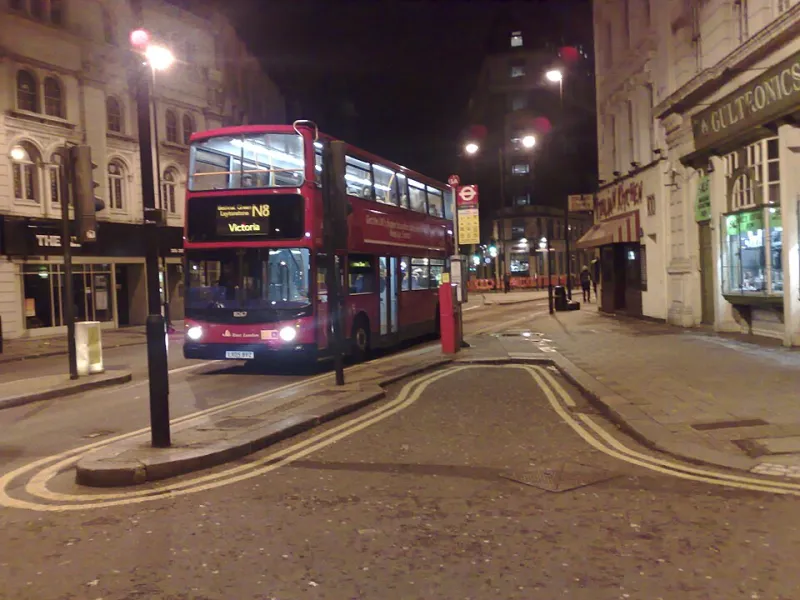
Photo: Mark Kobayashi-Hillary from London, United Kingdom, CC BY 2.0, via Wikimedia Commons
The last bus is a rhythm section
The N29 at 3 a.m. is not a romantic idea. It is a diesel hum, a door that hisses like a snare with a grudge, and a bloke called Dave explaining his take on warehouse parties to someone who stopped listening two stops ago. That is exactly why it works as source material. A night bus is a moving arrangement: engine drone as drone, door thump as transient, chatter as mid-range texture. In 2026, with phones that record cleanly and tiny interfaces that fit in a coat pocket, you can capture the whole thing without turning the top deck into a session.
This is a field-recording guide for acid producers, not a licence to be weird at strangers. The aim is to get the bus out of the bus and into a 303 line. The method is simple: record politely, edit ruthlessly, and let the vehicle keep its own groove.
The 3 a.m. recording kit and what not to do
You need less than you think. A phone with a decent mic, a small recorder if you have one, headphones you can monitor at low volume, and a coat with a pocket that does not rustle like a crisp packet. Set the phone to airplane mode if you are using it as a recorder; nothing ruins a take like a notification pinging through the preamp. Record at 48 kHz, 24-bit if the app allows, and aim for peaks around -12 dBFS. Phone-safe levels mean you are not clipping the engine rumble and you are not holding the phone above your head like a periscope.
Etiquette matters. Sit near the back, keep the phone on your knee, dim the screen, and do not point it at anyone. If a passenger asks what you are doing, say you are recording the bus for a track. Most people will shrug. Some will tell you about their cousin's techno night in Croydon. That is a bonus, not a sample. Do not record staff, do not record arguments, and do not use identifiable voices. If you would not want your own Tuesday-night chat in a club tune, do not put someone else's there.
The legal pitfalls are mostly about announcements. The bus's recorded announcements, chimes and branded jingles are not yours to use as a hook. They may carry performer rights, they are certainly not cleared for your white-label, and they can make a track feel like a novelty record rather than a night-bus acid cut. Use them as texture only if you process them beyond recognition: pitch them down, chop them into single syllables, run them through a granulator until they are just mouth-shaped noise. The same goes for any music leaking from someone's phone. You want the bus, not the bus's playlist.
Finding the groove before you touch the 303
The bus has a pulse, but it is not a metronome. The engine settles into a low thrum, the door hisses on a loose cycle, the indicator ticks, the bell pings, and the suspension knocks over road joints. Your job is to find the four-bar section where those events repeat closely enough to feel like a pattern. Record five minutes of the steadiest stretch you can get, then listen back with a tempo tap. You are not looking for perfect timing. You are looking for a pocket.
Once you have a loop, separate the layers. The engine drone is your bed. The door hiss is a closed hat with too much top. The bell is an accent, not a downbeat. The road-joint thump is a kick shadow, and the chatter is mid-range glue. If you are using a DAW, slice the recording into clips and name them like a band: engine, door, bell, chatter, thump. Then build a rough grid. Set the project tempo to wherever the bus feels comfortable, usually somewhere between 124 and 130 BPM for acid, and nudge the field clips until the thump lands just behind the grid. That slight lag is the secret groove. Do not quantise it to death.
The 303 line should not fight the bus. Program a simple pattern first: root note on the downbeat, a slide on the offbeat, an accent where the door hisses. Use the door hiss as a sidechain key to duck the 303 for a few milliseconds, so the bus appears to push the synth out of the way. If you are using a 303 emulation, keep the resonance under control; the bus already has plenty of upper-mid grit. A little overdrive on the 303 plus a low-pass filter opening over eight bars will do more than a hundred plugins.
Arrangement: keep the ride moving
The mistake is to start with the kick and the 303 at full tilt. A night bus does not work like that. It arrives, it idles, it hisses, it pulls away. Build the arrangement like a journey. Open with engine drone and a distant door hiss. Let the chatter sit low in the mix, filtered so it feels like the top deck rather than a podcast. Bring in a muted kick for four bars, then the full kick. Save the 303 for the first gear change. When the first acid line arrives, it should feel like the bus finally overtakes the night.
Use the bell sparingly. If you put it on every bar, it becomes a cowbell. Use it at the end of phrases, or as a transition into the break. The break is where the announcements can live, but only as degraded texture. Filter them down to a murmur, add reverb, and let the engine swell underneath. Then drop back into the 303 with the door hiss as the only hat for four bars. That is the moment the dancefloor leans in.
Keep the low end clean. The engine drone will eat your bass if you let it. High-pass the drone around 40 Hz, or sidechain it to the kick so the club system gets a clear punch. Check the mix on a phone speaker and on a club-style system if you can. The bus should be a texture, not a fog. If the track sounds like you are inside a diesel engine with a 303 taped to the dashboard, you have gone too far. If it sounds like a house record with a faint memory of the last bus home, you are close.
The last stop
Night-bus acid is not about novelty. It is about using a place that already has rhythm, and trusting that rhythm to do some of the arranging for you. Record politely, clear anything that needs clearing, and process the bus until it belongs to the track. Then take the 303 line out for a test drive. If the door hiss makes you nod before the kick comes in, you have got the secret groove.