Concrete Tails: Sampling UK Stairwells for Remix Reverbs

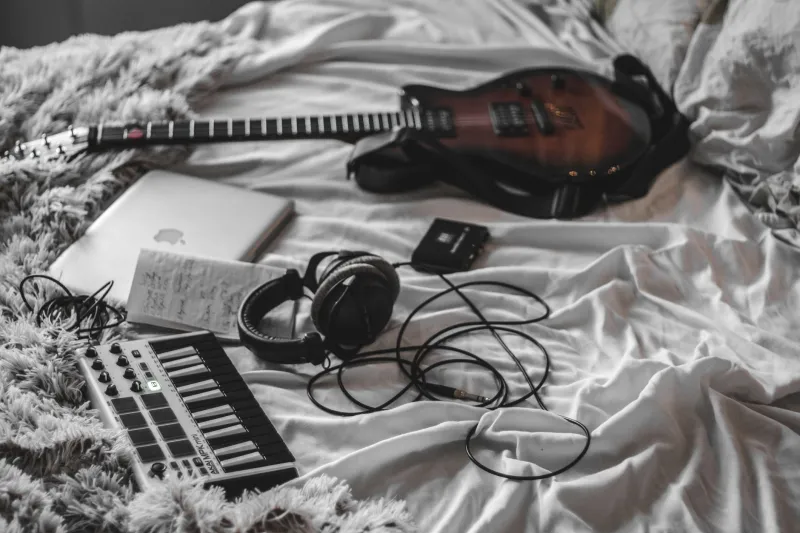
Photo by Photo by Artem Zhukov on Unsplash on Unsplash
There is a particular sound to a UK council block stairwell at 2am. It is not glamorous. It is concrete, painted metal, maybe a fire door that never quite closes, and a tail that hangs around just long enough to make a single clap feel like a moment. That tail is free. You just have to capture it properly.
Convolution reverbs are only as good as the impulse responses you feed them. Most of us load the same glossy hall or plate and wonder why the vocal still sounds like it was recorded in a cupboard. The answer is often architectural. A real space gives you irregular reflections, damped corners, flutter echo and a bit of dirt. A stairwell in Peckham will do more for a dry vocal than a dozen presets called London Plate.
Why concrete sounds better than your plugin
Algorithmic reverbs are brilliant at being clean. They are less brilliant at being specific. A convolution reverb uses a recorded impulse response, which is a snapshot of how a real room responds to a sound. That snapshot includes the awkward bits: the slap off a tiled wall, the low thump from a stair landing, the way high frequencies die faster than you expect.
UK architecture is full of usable spaces. Stairwells, underpasses, multi-storey car parks and pedestrian subways all have hard surfaces and long-ish tails. They are not studios. That is the point. The imperfections are the character.
Which everyday spaces actually work
Not every concrete box is worth recording. A good space usually has hard walls, a decent ceiling height and not too much soft furnishing. Here is a quick field guide.
- Council block stairwells: tight flutter echo, short-to-medium tail, brilliant for vocals, claps and snare smacks. The metal handrails add a subtle ring.
- Multi-storey car parks: longer tails, low-frequency build-up and a slightly industrial edge. Great for dub snares and drum room mics.
- Pedestrian underpasses: slapback and tunnel tone. Often better for guitars, percussion and effects than full mixes.
- Empty car parks after hours: huge, but watch out for wind and traffic noise. A quiet Sunday morning is not always quiet.
- Tiled public toilets: not glamorous, but a genuinely useful bright tail for cheap 90s-style vocal throws. Keep the session short and respectful.
Avoid anywhere that is unsafe, private, or likely to get you moved on. A stairwell is a shared space, not a free studio.
The kit and the capture
You do not need a measurement mic. A phone voice memo app can work if you are careful, especially for claps and short percussive hits. A cheap condenser and an audio interface will give you more control and less phone processing.
The simplest method is the clap impulse. Stand in the space, make a sharp clap or snap a balloon, and record the tail. Do it several times from different positions. Keep the mic still and avoid moving your feet. If you want a cleaner result, use a sine sweep played from a small speaker and record the response with a mic, then deconvolve it in software. That is more accurate, but the clap method is faster and often more musical.
Practical settings: record at 48kHz if you can, leave plenty of headroom, and avoid any phone EQ or noise reduction. Record the space silent for 20 seconds too. That room tone is useful for blending and for hiding edits later.
Etiquette, access and council rules
This is the part people skip. Do not prop fire doors open. Do not block stair landings, bin stores or exits. Do not drill, mount mics permanently or leave gear unattended. If you are in a council block, ask the caretaker or housing officer first. A short polite conversation is better than a noise complaint.
Keep sessions brief. Avoid peak times. Do not record residents coming and going, and do not use the stairwell as a social space. If someone asks what you are doing, explain it simply and offer to move. The best impulse responses are useless if you have annoyed an entire floor.
Turning a clap into a convolution IR
Back in the DAW, trim the recording so it starts just before the transient. Fade the tail gently. Normalise, then high-pass around 80 to 120Hz to remove rumble. You can low-pass around 12 to 16kHz if the space is hissy. If you used a sweep, run your deconvolver and export a mono or stereo WAV. Name it clearly: Peckham stairwell clap, long tail, mono.
Load it into your convolution reverb. Put the reverb on a send, set it 100 per cent wet, and blend the send into the dry signal. That gives you control. If the tail feels too long, shorten the IR or use the reverb decay control. If it feels too dense, try a mono IR. Mono stairwells often sit better in a busy mix than stereo ones.
Before and after: dry vocal to Peckham tower block
Take a clean vocal. No reverb, no delay, just a bit of compression and EQ. Set up a send to your stairwell IR. Start with the send low, around 10 to 15 per cent, and bring it up until you hear the space. Add 20 to 30ms of pre-delay so the words stay clear. High-pass the reverb return at 200Hz and low-pass it around 8kHz. That stops the tail from muddying the low mids and makes it sound more like a broadcast than a wash.
Now automate the send. Push it on the last word of a line, pull it back on the next phrase. If the vocal is busy, use the stairwell on ad-libs and doubles rather than the lead. Suddenly the vocal has a location. It sounds like it was recorded in a tower block hallway, not in a bedroom with a duvet over the mic.
Mix tips that keep it musical
Convolution is seductive. It is easy to drown everything. Use it in parallel, high-pass the return, and check the mix in mono. If the tail masks the snare, shorten it. If the vocal loses intelligibility, increase the pre-delay or reduce the send. A little goes a long way, especially on a club mix where the low end needs room.
The best results often come from using two spaces: a short stairwell for drums and a longer car park for vocals or effects. That gives you depth without turning the whole track into a cave.
Capture a few spaces this month. Label them properly. You will end up with a small library that sounds like your city, and that is far more useful than another preset called Big Room.